Most of the anxiety around a first massage abroad comes from not knowing the sequence. Here is the whole thing, from the door to the tea afterwards.
Arrive 10–15 minutes early, wear something loose and comfortable, and expect the spa to provide what you actually wear during the treatment. For an oil massage you undress to your underwear under a towel; for Thai massage you stay clothed in a loose set they hand you. Pressure is adjustable at any point — say so in the first five minutes.
A first massage in Vietnam is not complicated, but it is unfamiliar enough that people spend the first fifteen minutes tense — which is precisely the opposite of the point. Almost all of that tension comes from three unknowns: how much clothing comes off, whether it is acceptable to say the pressure is too strong, and what happens with money at the end.
This guide answers all three, plus the twenty smaller questions underneath them. It is written for visitors booking their first treatment in Da Nang, whether that is at a street-front shop on Hoàng Sa or a private spa in An Hải.
It matters less than people think, because you will not be wearing it. Every spa above street level provides either loose cotton Thai trousers and a top, or a robe and disposable underwear.
What actually helps: clothes that are easy to take off and put back on, and that do not crease badly while folded in a basket for two hours. Linen shirts and anything that needs tucking in are the wrong choice. A t-shirt and shorts are the right one. If you are going straight out afterwards, bring a change — oil-based treatments leave residue on skin and hair regardless of the shower.
Leave jewellery at the hotel. You will be asked to remove it anyway, and one less thing in a locker is one less thing to forget.
Leave 60–90 minutes between a full meal and your appointment. Lying face down for an hour on a full stomach is genuinely unpleasant, and Thai massage involves abdominal pressure and spinal twisting that makes it worse. Arriving hungry is not better — low blood sugar plus deep relaxation is how people get lightheaded standing up afterwards. A light snack an hour before is the sweet spot.
Skip the alcohol beforehand. Massage increases circulation, which accelerates its effects, and most therapists will decline to treat a visibly intoxicated guest.
In Da Nang, same-day is usually fine outside peak periods. Two situations warrant booking ahead: a couples room, because most spas have only one or two, and four-hand massage, because it requires two therapists free at the same time. Evenings between 18:00 and 20:00 are the busiest window across the city.
The sequence is consistent across Da Nang spas above the very cheapest tier:
This is why arriving 10–15 minutes before your booked time matters. All five steps sit outside your treatment window at a well-run spa. Arrive at exactly your booked time and something gets compressed — usually the end of your massage, because the room is needed.
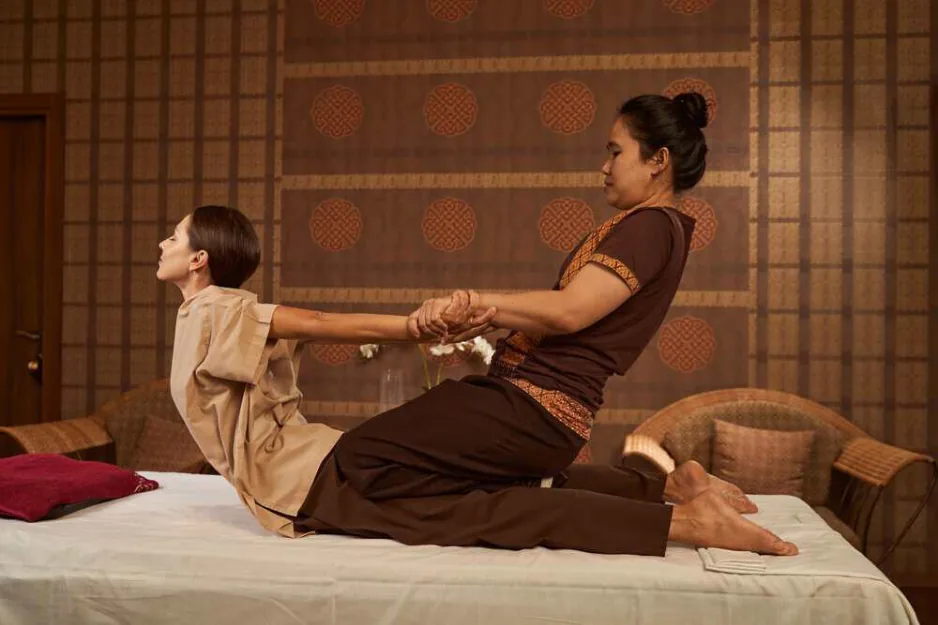
This is the single most-searched anxiety about a first massage, so here it is without euphemism.
You change alone. The therapist shows you the room, explains what to remove, and leaves. They knock and wait before coming back in. At no point does anyone watch you undress.
You stay fully clothed. You change into loose cotton trousers and a wide top the spa provides, and the session happens on a floor mat. No oil, no towel, no exposure. If undressing is your concern, Thai massage removes it entirely — this is a large part of why it suits nervous first-timers.
You undress to your underwear, or use the disposable underwear provided if you prefer. A towel or sheet covers you for the whole session. The therapist uncovers only the limb or area being worked on and re-covers it before moving on — this is standard practice, not a courtesy extended to shy guests.
You may keep your bra on if you want to; it limits back work slightly and any therapist will simply adapt. Nobody will comment.
Nothing comes off but your shoes and socks. Trousers are rolled to the knee. Foot massage is usually done in a reclining chair, sometimes in a shared lounge, and is the least exposed treatment on any menu.
Vietnamese massage tradition runs firmer than the Western spa norm. A therapist working at what they consider a standard, therapeutic pressure may be applying considerably more force than a first-time guest expects — and many guests, not wanting to seem difficult, simply endure it.
Do not endure it. Adjusting pressure is a routine part of the job and asking causes no offence whatsoever. What does cause a problem is saying nothing for an hour and leaving bruised.
| What you want | Vietnamese | Roughly pronounced |
|---|---|---|
| Lighter, please | Nhẹ hơn | nyeh hun |
| Stronger, please | Mạnh hơn | manh hun |
| That hurts | Đau | dow |
| That's good / just right | Được rồi | duck roy |
| Thank you | Cảm ơn | kam un |
Pronunciations are approximations for English speakers; Vietnamese is tonal and these will not be perfect. Every one of them is understood at any Da Nang spa, and "lighter please" in English works nearly everywhere too.
Say something in the first five minutes. Therapists calibrate early and then settle into a rhythm; a correction at minute three is easy, a correction at minute forty means most of the session already happened at the wrong pressure.
Tell us it is your first massage when you message. We will walk you through the room, the pressure and the timing before you arrive.
A few things that surprise first-timers, none of which are problems:
If anything at all feels wrong — the temperature, the music, the pressure, the position — say so. A spa would far rather adjust at minute ten than hear about it in a review.
Expect to feel slightly disoriented for a few minutes. That is normal; stand up slowly. The usual sequence is a few minutes lying still, then tea, then the shower if the spa has one.
Drink water. The common claim that massage "flushes toxins" is not supported by evidence, but the more mundane reason holds: you have been lying still in a warm room, and after deep tissue work mild soreness the next day is common. Hydration helps with that.
Two practical points:
After deep tissue or Thai work, some next-day tenderness is normal and usually resolves within 24–48 hours. Sharp pain, bruising or numbness is not normal — that is a signal the pressure was too high, and worth mentioning to the spa.
Confirm the total before the session, not after. One message or one sentence at reception — "so that's 700,000 total for 90 minutes with the sauna?" — removes every possible ambiguity while you can still change your mind.
Cash in Vietnamese Dong is the smoothest payment method. Cards are widely accepted but many spas pass on a 3–8% processing fee, and if the terminal offers to charge you in your home currency, decline — the conversion rate is reliably worse than your bank's.
Tipping is not obligatory in Vietnam, and declining to tip is not rude. If you were happy with the session, 50,000–100,000 VND handed directly to the therapist is normal and well received. Check the bill first — some spas already include a service charge.
Hand a tip to the therapist rather than leaving it at reception. That is both the local convention and the more reliable way for it to reach the person who did the work. Wise's guide to tipping in Vietnam covers the same norms across restaurants, taxis and hotels if you want the broader picture. For what the session itself should cost, see our Da Nang massage price guide.
Massage is safe for most people, but there are genuine contraindications. Disclose these on the health form, and expect a good spa to adapt the treatment or decline it:
None of these are reasons to stay quiet. A therapist who knows about your shoulder injury works around it; a therapist who does not may make it worse.
If you are choosing blind, this is the shortest useful answer:
| If you... | Book | Why |
|---|---|---|
| Are nervous about undressing | Thai massage | Fully clothed throughout, no oil. |
| Want to switch off completely | Aroma massage | Slow, warm, oil-based; the most sedating option. |
| Have walked all day | Foot massage | Targeted, cheapest, and the least exposed. |
| Are travelling as a couple | Couples massage | One room, two therapists, same schedule. |
| Have one evening and want the memorable one | Four-hand massage | Two therapists in sync; unlike anything at home. |
A fuller comparison of the techniques themselves is in our guide to Thai vs aroma vs four-hand massage.
Arrive fifteen minutes early. Wear something you can take off easily. Say "lighter" in the first five minutes if the pressure is more than you want. Keep your underwear on if you prefer, or book Thai massage and keep everything on. Confirm the price before, tip after if you feel like it, and drink some water.
That is the entire ritual. The rest is just lying there, which you already know how to do.
Private rooms, English and Korean spoken, and free hotel pickup for two or more guests within 5 km. No reservation required.
6 Loseby, An Hải, Da Nang · Open daily 09:00–21:00