Four treatments, four genuinely different things happening to your body. The menu rarely explains which one solves the problem you actually walked in with.
Thai massage stretches you, clothed and without oil. Aroma massage relaxes you, with warm oil on bare skin. Four-hand massage is an aroma massage delivered by two therapists at once. Foot massage targets feet and calves in a chair. Choose Thai for stiffness, aroma for stress, four-hand for the deepest switch-off, foot for tired legs.
Every spa menu in Da Nang lists these four, and most list them as if the only difference were price. They are not variations on one thing — they come from different traditions, work on different tissue, and produce genuinely different results.
This guide compares them on what actually matters: what the therapist does, how it feels, what you wear, and which one to pick for the specific reason you are considering a massage at all.
| Thai | Aroma / oil | Four-hand | Foot | |
|---|---|---|---|---|
| Oil used | None | Yes | Yes | Balm or oil, lower legs only |
| What you wear | Loose set provided | Underwear, under a towel | Underwear, under a towel | Your own clothes |
| Surface | Floor mat | Table | Table | Reclining chair |
| Pressure | Firm, rhythmic | Medium, flowing | Medium, continuous | Firm, targeted |
| Stretching | Central to it | Minimal | Minimal | None |
| Best for | Stiffness, desk backs, hips | Stress, sleep, sunburn-free skin | Total switch-off | Tired legs and feet |
| Bana Spa from | 520,000 VND | 450,000 VND | 720,000 VND | 550,000 VND |
Bana Spa 60-minute rates after the direct 20–30% discount. Full menu on the pricing page; city-wide ranges in our price guide.
Thai massage is the outlier on the menu, and the one most often mis-bought. It uses no oil, no table and no undressing. You wear a loose cotton set the spa provides and the session happens on a floor mat.
The therapist works along sen lines — the energy channels in Thai traditional medicine — using palms, thumbs, forearms, elbows, knees and sometimes feet to apply sustained compression. Interleaved with that compression is the part that defines it: assisted stretching. Your arms, legs, hips and spine are moved through positions you could not comfortably reach alone. It is sometimes described as "lazy yoga", which undersells the compression work but captures the feel.
Active rather than soothing. There is rhythm and pressure, moments of real intensity when a stretch reaches its end range, and a distinct sense of having been worked on rather than pampered. Most people finish a Thai massage feeling loose and awake, not sleepy.
More detail on the sequence and pressure on our Thai massage page.
Aroma massage is the Da Nang default, and for good reason — it is the most forgiving treatment on any menu. Warm essential oil, long gliding strokes, a table, and a towel covering everything not currently being worked on.
The distinction between an "oil massage" and an "aroma massage" is worth knowing: an oil massage uses oil as a lubricant; an aroma massage uses therapeutic essential oils chosen for their botanical properties. The scent engages the nervous system while the strokes work the tissue. Whether the oils do more than that is contested; that they make the session more pleasant is not.
Slow, warm and sedating. Long unbroken strokes down the back, focused work on shoulders and neck, and a pace designed to drop your heart rate. It is the treatment people fall asleep during.
Hot stone places heated basalt stones along the spine and shoulders. The heat lets the therapist reach deeper tissue with less force, which is why it suits people who want depth without discomfort.
Herbal compress is a muslin bundle of steamed herbs pressed into tight areas. It delivers concentrated heat plus the aromatics of the herbs, and works particularly well on shoulders and lower back.
Both work better on a body that is already warm, which is the argument for putting a sauna in front of the treatment — see full body massage and sauna for how the two fit together.
Some Da Nang spas charge 100,000–200,000 VND for each. At Bana Spa both are built into the aroma massage rather than added on — worth checking, because it changes the real price comparison between menus considerably.
Tell us what hurts, how you sleep, and how long you have. We will tell you which of the four to book — including if the answer is the cheapest one.
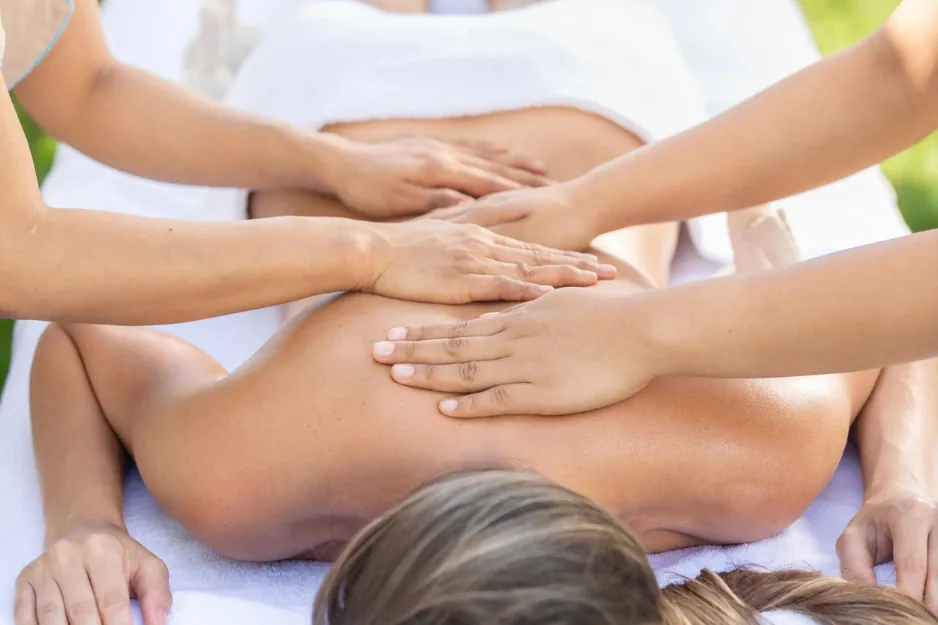
Two therapists, one guest, the full session. In practice it is an aroma massage delivered in stereo — mirrored strokes on both sides of the body at the same time, choreographed so the two pairs of hands stay in rhythm.
The common assumption is that this means twice the pressure or twice the coverage. Neither is really the point. The effect is neurological. During a normal massage your brain quietly tracks where the therapist's hands are and anticipates the next stroke — a low-level background process you are not aware of. With four hands moving symmetrically, that prediction fails. Within a few minutes most people stop trying, and the drop into relaxation is faster and deeper than a single therapist produces.
It is the treatment guests most often describe as unlike anything available at home, largely because two therapists for an hour is prohibitively expensive in most Western markets and merely a premium option here.
Book ahead — it needs two therapists free simultaneously, which is the real constraint. Expect roughly double the price of the equivalent aroma massage; at Bana Spa four-hand starts at 720,000 VND against 450,000 for aroma. And 90 minutes suits it better than 60: with two therapists the body coverage happens faster, so a longer session is where the depth arrives.
Easy to dismiss as the cheap option, and wrong to. In a city where visitors walk the Dragon Bridge, the beach, the markets and Sơn Trà in the same week, foot massage solves the most common actual complaint more directly than anything else.
A proper Da Nang foot massage is not just feet. The sequence usually runs: herbal foot soak, then acupressure through the soles, then work up through the calves and shins — which is where most walking fatigue actually lives. Many spas include a short shoulder and neck section at the end while you are in the chair.
It is also the least exposed treatment on the menu — shoes and socks off, trousers rolled to the knee, nothing else — which makes it a sensible first booking for anyone uncertain about the whole experience. Details on our foot massage page.
A massage is a treatment. A spa is a venue. Massage is hands-on manipulation of muscle and soft tissue. A spa is the place and the wider service around it — private rooms, herbal foot soak, sauna, bath, tea, showers, and often facials, scrubs and nail services alongside. Every spa offers massage; not every massage shop is a spa.
This matters when comparing prices. A 350,000 VND massage at a shop and a 550,000 VND massage at a spa are frequently the same treatment — the difference is a private room with a door, a shower, a foot soak, and somewhere to sit afterwards. Whether that gap is worth 200,000 VND depends entirely on what you want from the hour, and there is no wrong answer.
| Your situation | Book | Length |
|---|---|---|
| Just landed, long flight, stiff everywhere | Thai | 90 min |
| Walked 20,000 steps, legs are done | Foot, with calf work | 60 min |
| Stressed, sleeping badly | Aroma with hot stone | 90 min |
| Desk-worker neck and shoulders | Aroma with herbal compress | 60–90 min |
| Sunburnt from the beach | Foot massage only | 60 min |
| Travelling as a couple | Couples aroma | 90 min |
| One evening, want the memorable one | Four-hand | 90 min |
| Pregnant | Ask specifically for prenatal-trained therapists | 60 min |
| No idea, just want a good massage | Aroma with hot stone | 90 min |
If you would rather not travel to any of it, our guide to hotel massage and spa pickup compares the two ways of getting a treatment without arranging your own transport.
The last row is the honest default. If you are stuck, book a 90-minute aroma massage with hot stone. It suits nearly every body, asks nothing of you, and the added heat makes it meaningfully better than a plain oil massage for a small difference in price.
The choice of technique matters less than most people assume. The choice of duration matters more.
Sixty minutes is a complete treatment, but a meaningful share of it is setup, turnover and the first pass over the body. Ninety minutes is where a therapist can go back over the areas that needed it. And because spas price longer sessions at a discount per minute — a 120-minute aroma massage costs about 1.6× a 60-minute one, not 2× — the second half hour is the best value on any Da Nang menu.
If you are deciding between a 60-minute four-hand and a 90-minute aroma at a similar price, take the 90 minutes. Depth beats novelty for most people, most of the time.
Thai for stiffness. Aroma for stress. Four-hand for the evening you want to remember. Foot for the day you walked too far. And when in doubt, take the extra thirty minutes over the fancier technique — it is cheaper and it works better.
Tell us what hurts and how long you have. We will recommend the treatment that fits — including when that is the cheaper one.
6 Loseby, An Hải, Da Nang · Open daily 09:00–21:00