Himalayan salt sauna, a hot shower, then a full-body massage with essential oils and hot stones. Most spas sell the combination. Very few explain why the sequence matters.
A full body massage and sauna session runs in one order: heat first, massage second. Thirty minutes in a Himalayan salt dry sauna and a hot shower raise skin and muscle temperature, so the therapist works deeper with less pressure. The massage that follows uses warm essential oils and heated stones to hold that warmth in place.
You can book the two separately, and most spas in Da Nang will happily let you. But the sauna does more than fill twenty pleasant minutes before a treatment you were going to have anyway. It changes how the treatment feels. Pressure that would make you tense up on a cold body reads as firm and comfortable on a warm one.
This guide covers the sequence, the timing, what the heat does to circulation and skin, what the combination costs across Da Nang, and when to ask for the massage without it.
Three separate things get bundled under one name on Da Nang spa menus, so it is worth separating them before comparing prices.
The sauna is a heated wooden room, usually dry and somewhere between 60 and 80 °C. A Himalayan salt sauna is the same thing with a wall of salt blocks lit from behind. The warm pink light is much of why the room feels calming rather than clinical. Thirty minutes is the standard session and is plenty.
The hot shower sits between the sauna and the table. Five minutes, and it is doing real work: sweat left on the skin makes oil slide rather than grip, and the therapist needs grip.
The massage is a full-body oil treatment covering every major muscle group, worked in long slow strokes rather than short deep ones. At Bana Spa this is the aroma massage, with essential oils and heated basalt stones. Our guide to Thai vs aroma vs four-hand compares it against the alternatives if you are still deciding.
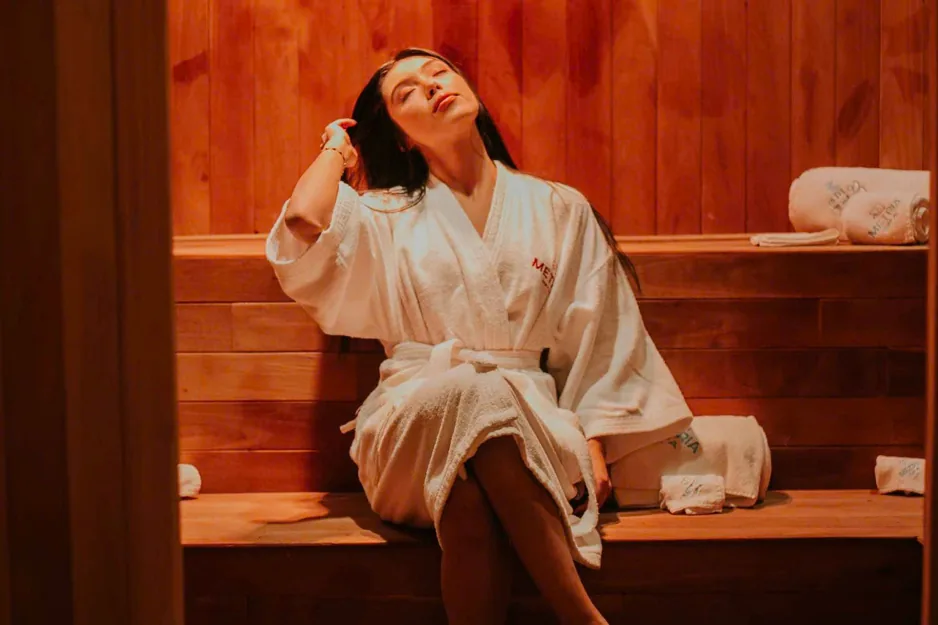
Ask for a massage on a cold body and the first ten or fifteen minutes go on something the therapist would rather not spend them on: warming you up. Long strokes, pressure climbing slowly, waiting for the tissue to give. It works, but it is fifteen minutes of your hour.
A sauna does that in advance and does it more thoroughly, because heat reaches tissue that hands cannot. By the time you are on the table your muscle temperature is up, the connective tissue is more compliant, and the therapist starts at working depth instead of climbing to it.
Most people notice the consequence immediately: the same pressure hurts less. Guests who normally ask for medium often ask for firm after a sauna. The tissue has stopped bracing. If you have avoided deep work because it was unpleasant, this is the version to try.
Going the other way round is fine, just different. Sauna afterwards is a wind-down, and some guests prefer to end the visit sweating rather than start it. It does nothing for the massage, though, because the massage is already over.
One exception: if you have come straight off a long-haul flight or a full day in the sun on Mỹ Khê, skip the sauna and go to the table. Dehydrated or sunburnt skin gets nothing from more heat.
The skin flushes in a sauna for a straightforward reason. Heat load makes the body dump warmth to the surface, so the vessels near the skin widen and more blood moves through them. Heart rate rises modestly, roughly to the level of a brisk walk. Harvard Health's overview of saunas and your health is a level-headed summary of what the research supports and what it does not.
Massage adds a mechanical version of the same thing. Pressure moving consistently towards the heart shifts fluid through the veins and the lymphatic system, which is why therapists work up the calf rather than down it.
Together they handle what most guests walk in with: heavy legs after a week on foot, or a neck that never recovered from the flight. Be sceptical of anything stronger. A sauna is not a detox and a massage does not flush toxins. It makes you feel considerably better for a couple of days, which is what you were buying.
The heat opens things up and the oils go on afterwards, which is the right order for skin as well as for muscle. Warm skin takes oil more readily, and the sweat and the shower between the stages leave a clean surface for it.
There is a local argument on top of the general one. Salt air, strong sun and air conditioning running all day are a drying combination, and most visitors arrive at the spa with skin in worse condition than they left home with. A full-body oil treatment is the most thorough moisturising most people get on a trip, simply because someone else is applying it and covering every part of you.
The oils stay on your skin, so do not book this an hour before a dinner reservation unless you plan to shower again. And if you have sensitive skin or a fragrance allergy, say so at reception. An unscented base oil is always available.
Thirty minutes in the Himalayan salt sauna with a 60-minute full-body aroma massage. Hot stone and herbal compress are included in the price.
Hot stones and a sauna get confused on menus often enough to be worth separating properly. A sauna heats the whole body from the outside, before the treatment. Hot stones are smooth basalt stones, heated in water to around 50 °C, that the therapist uses during the treatment, either resting them along the spine to hold heat in one place or working with them as an extension of the hand.
They belong in the same session because a sauna's warmth fades. Twenty minutes into a massage in an air-conditioned room, the effect is receding. Stones put heat back into the areas that need it, usually the upper back and shoulders, and let the therapist hold pressure in one spot without the discomfort a thumb in the same place would cause.
Many Da Nang spas charge hot stone as a 100,000–200,000 VND add-on, and some charge herbal compress separately on top. Bana Spa builds both into the aroma massage instead. That is unusual for the city, so ask any spa which model they use. Our Da Nang massage price guide goes through the add-ons that commonly appear on the bill.
The common scheduling mistake is booking a 60-minute massage and assuming you will be out in an hour and ten. The sauna is 30 minutes on its own, and the stages either side of it add up.
| Stage | Time | What happens |
|---|---|---|
| Arrival, tea, changing | 5–10 min | Robe and disposable underwear, herbal foot soak, treatment agreed. |
| Himalayan salt sauna | 30 min | Dry heat. Leave earlier if you want to; nobody is timing you. |
| Hot shower | 5 min | Rinses the sweat so the oils grip. Worth the five minutes. |
| Full-body oil and hot stone massage | 60–120 min | Back, shoulders, arms, legs, feet, finishing with neck and scalp. |
| Tea, dressing, paying | 10 min | Get up slowly. Sit for a minute before you stand. |
Typical structure at a private Da Nang spa, September 2026. Total: about two hours for a 60-minute massage, about two and a half for a 90-minute one.
If your afternoon is tight, say so when you book. A spa can shorten the sauna to fifteen minutes, or drop it and give you the full massage time. That is a far better trade than losing twenty minutes off the table.
Prices below were surveyed from published Da Nang spa menus in September 2026, in Vietnamese Dong, with dollar equivalents at roughly 25,000 VND to the dollar.
| What you book | Typical Da Nang range | Notes |
|---|---|---|
| Sauna alone, 30 min | 150,000–250,000 VND | Usually only sold alongside a treatment, not on its own. |
| Hot stone add-on | 100,000–200,000 VND | Bundled at some spas, charged at others. Ask. |
| 60-min oil massage + 30-min sauna | 550,000–1,100,000 VND US$22–44 | The standard combination. The band is wide because room privacy varies. |
| 90-min massage + sauna | 900,000–1,600,000 VND US$36–64 | Better value per minute, because the fixed costs are already paid. |
| VIP or signature package | 1,200,000 VND and up | Private suite with its own shower, senior therapist, sauna included. |
Ranges surveyed from published Da Nang spa menus, September 2026. Individual spas fall outside these bands in both directions.
For reference, Bana Spa's own published rate for the 60-minute aroma massage with the 30-minute Himalayan salt sauna is 1,000,000 VND, with a direct discount applied at the spa and no reservation needed. The sauna on its own is a 200,000 VND add-on to any treatment. The full menu is on the price list.
Adding the sauna to a longer massage is better value than adding it to a short one, wherever you book. The sauna price is fixed and the per-minute massage rate drops as the session lengthens, so a 90-minute massage with sauna costs less per minute than a 60-minute one with the same sauna.
The sauna is the part with actual contraindications, and a good spa asks before selling you one. If any of the following apply, ask for the massage without the sauna rather than skipping the visit.
Beyond that the ordinary advice holds. Drink water before and after, do not go in on a full stomach, and get off the table slowly. After heat and an hour face down, standing up quickly is how people get dizzy. Our first-massage guide covers the rest of the etiquette, including how much clothing comes off and how to ask for lighter pressure.
If you are staying near the beach, most private spas in An Hải and An Thượng run a pickup car; Bana Spa collects two or more guests within 5 km at no charge. The hotel massage and spa pickup guide explains why being collected beats having a therapist come to your room, particularly for a treatment built around a sauna nobody can bring with them.
Book the sauna before the massage. Take the hot shower in between, give the whole thing two hours rather than one, and put it at the end of a day you spent walking rather than the start of one you have not had yet.
The surprise is rarely the sauna itself. It is that thirty minutes of heat changes how much pressure you can comfortably take, and a massage you can take firm is a different thing from one you can only take light.
The three price tiers, what is bundled in, and why 120 minutes never costs double.
Which treatment matches what your body is actually asking for.
What to wear, what happens when you arrive, and how to ask for less pressure.
Tell us the length you want and whether the sauna goes before or after. We will confirm the total, discount included. No reservation required.
6 Loseby, An Hải, Da Nang · Open daily 09:00–21:00